Insights
Insights
Article
The questions you forget to ask before you sell: the story of Nicolas Quarré, Alexis Eggermont and Tino of Accountable
Business & Strategy
Jun 26, 2026
Article
The questions you forget to ask before you sell: the story of Nicolas Quarré, Alexis Eggermont and Tino of Accountable
Business & Strategy
June 26, 2026
Article
The questions you forget to ask before you sell: the story of Nicolas Quarré, Alexis Eggermont and Tino of Accountable
Business & Strategy
26/6/2026
Article
The questions you forget to ask before you sell: the story of Nicolas Quarré, Alexis Eggermont and Tino of Accountable
Business & Strategy
26/6/2026
Article
The questions you forget to ask before you sell: the story of Nicolas Quarré, Alexis Eggermont and Tino of Accountable
Business & Strategy
June 26, 2026
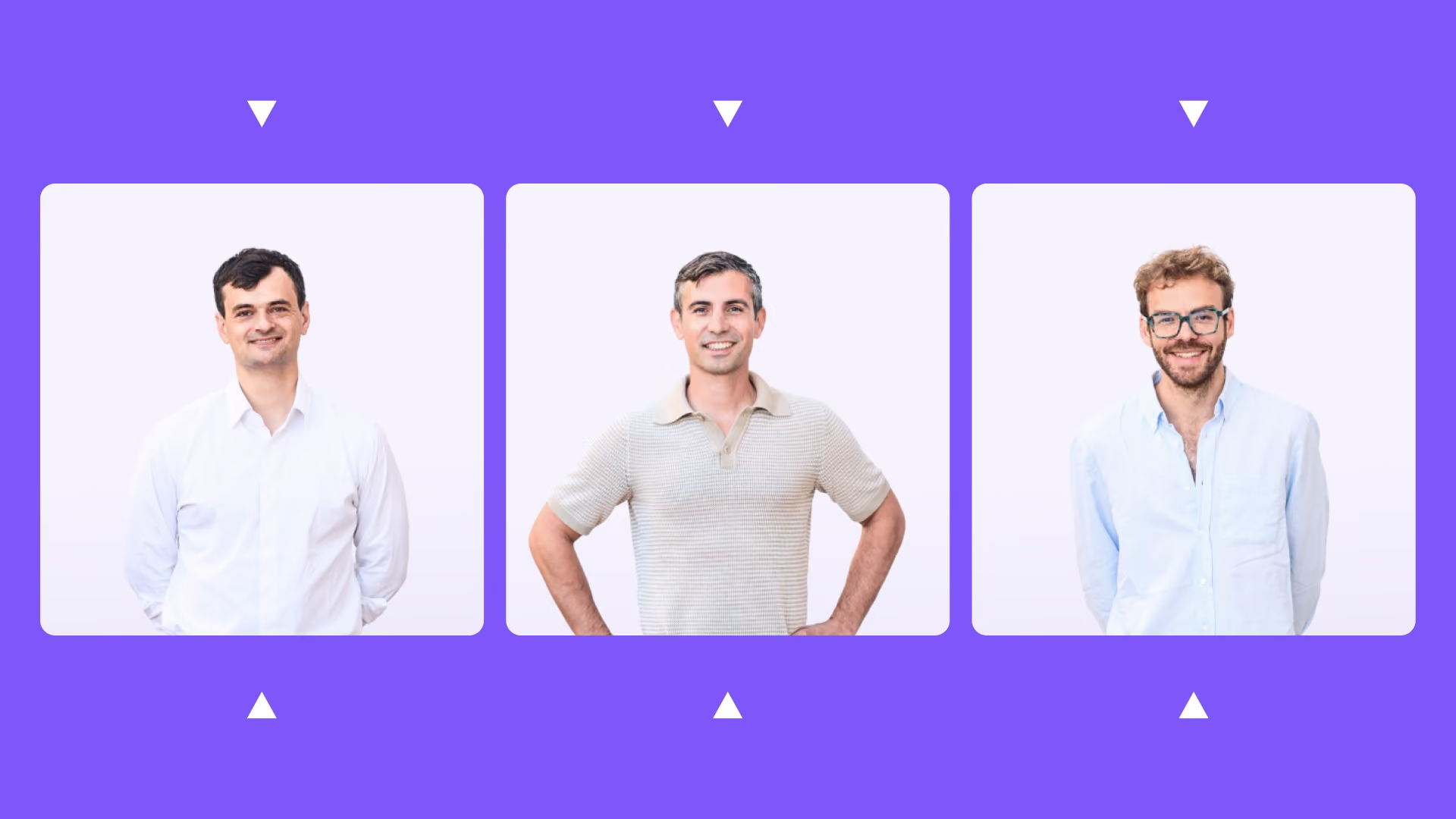
Nicolas Quarré spent four years living in Brazil for his work. Alexis Eggermont worked for Médecins Sans Frontières across several countries in Africa. Tino Keller built social platforms for children and digital media products before landing in fintech. Three people with entirely different paths who found each other around a single shared conviction: that the system for self-employed people was fundamentally broken, and that someone had to do something about it.
That someone turned out to be them.
Today, Nicolas Quarré, Alexis Eggermont and Tino Keller serve as CEO, CPO and CMO of Accountable, helping more than 100,000 self-employed people across Belgium and Germany manage their taxes, invoices and business finances. End-to-end, in one app, in their own language. But before we talk about the company, we start with the people.
"Something had to be done"
Tino Keller was in a different industry when he saw it. In the media sector, he had watched freelancers struggle with invoices, taxes, and the simple question of what they actually earned. "I'm especially drawn to markets where customer behaviour has moved on, but the market hasn't. With taxes for the self-employed, that was very much the case."
Nicolas Quarré knew the pain from a different angle. He grew up surrounded by self-employed people. He later worked in a data analytics business serving some of the world's largest telecoms operators. But every time he returned to Belgium, he encountered the same system. "The self-employed aren't asking for a better accountant. They want control and freedom."
For Alexis Eggermont, the trigger was the most concrete of all. As a self-employed professional with an accountant, he still couldn't understand his own finances. "My accountant was expensive, gave me no visibility into my money, and the whole process was manual. We just thought: this can be automated."
Three people. One diagnosis. Accountable was the logical consequence.
The second country: almost starting over
Accountable grew quickly in Belgium. The next chapter seemed obvious: Germany.
Nicolas Quarré soon remembers the harsh reality: "Everyone warns you that scaling into a second country is hard. Nobody quite prepares you for how hard when the product is tax." Germany isn't Belgium with a different language. It's a different regulatory regime, a different relationship with software, a different pattern of trust. "We had to almost rebuild the company to earn the right to compete there. But now that we have, the moat is real."
Alexis Eggermont looks at the internal tension that growth brings: "As you grow, the environment becomes more complex. More maintenance, more alignment, less tolerance for bugs. It's easy to end up in a situation where nothing moves anymore. Unless you're willing to make hard choices that make some people uncomfortable."
Tino Keller recognises the pattern from earlier ventures: "In every company I've built, I underestimated how long it takes to really nail product-market fit, and then product-channel fit. And even once you find something that works, it keeps changing. You're always building the boat while sailing it."
AI: no longer a feature, the foundation
Accountable had document recognition five years ago. A basic version of AI, built in. Today that almost sounds quaint, so different is the scale on which they now operate.
Alexis Eggermont describes it from the inside: "Almost all code is now written by AI. We're also using it to speed up design, QA and code review. It's a fascinating but challenging process, we're constantly chasing the bottleneck."
Nicolas Quarré looks at the strategic impact: "Five years ago, AI was a feature we added. Today, it's the substrate." The AI Tax Adviser, a virtual tax adviser built into the app, would have been unimaginable in 2021 at the price point that makes Accountable accessible. "We're a smaller company doing more. And the gap is only going to widen."
Tino Keller focuses on what that means for the person at the other end: "AI finally allows us to give the self-employed something that feels like a real tax adviser in their pocket: someone who explains things in plain language, whenever they need it, without judgement. But the human layer becomes more important because of that, not less. AI helps instantly, real coaches are there when it matters. That's the promise."
Saying yes to the right partner
In 2024, Accountable became part of Visma. What would they say to a founder considering an acquisition?
"Founders are optimists by nature. You believe in the upside but that same optimism can blind you to what can go wrong. The right acquirer should derisk the journey without killing the upside. More stability, more trust and more resources but still enough freedom to keep building in the way that makes the company successful. With Accountable, I feel we found that balance." - Tino Keller
Nicolas Quarré advises to make sure you're saying yes to a partner, not an exit: “The mechanics of the deal (earn-out, governance, autonomy clauses) are secondary. The only question that counts: do you actually want to keep building this company for the next five years inside the new structure? If the answer is yes, the rest is solvable."
Alexis Eggermont focuses on the personal aspect. Whether to sell is a deeply personal decision, depending on options and ambitions. But who you sell to matters at least as much as the valuation. “A deal is much more than a number. A relationship built over years, on the basis of trust, that makes the difference."
What they would pass on
We ended with the question that always reveals the most: what would you tell your younger self? These were the answers:
"Pick your co-founders the way you'd pick a marriage partner. You're going to disagree about everything that matters. What counts is whether you trust each other to disagree well." - Alexis Eggermont
"Keep some of your naivety. It helps you ask the questions others have stopped asking. And if you fully understood the ride ahead, you might not even start. At some point, naivety gives way to resilience. It's a rollercoaster, buckle up." - Tino Keller
"Choose the market and the customer you want to serve before you decide on the problem or the team. If things go well, you'll be doing it alongside them for the next ten years." - Nicolas Quarré

Tags
Share
About the episode
Share

/podcast-series/voice-of-visma
Share