Insights
Insights
Article
How Visionplanner scales by putting people first in a world of data
Business & Strategy
Apr 21, 2026
Article
How Visionplanner scales by putting people first in a world of data
Business & Strategy
April 21, 2026
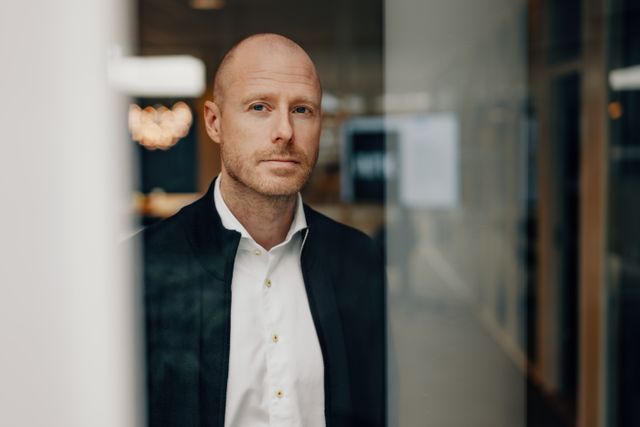
In the accounting sector, everything revolves around figures, automation, and efficiency. But for Joris Joppe, Managing Director of Visionplanner, the real key to sustainable growth is something else entirely: maintaining a human touch.

Article
How Visionplanner scales by putting people first in a world of data
Business & Strategy
21/4/2026
Article
How Visionplanner scales by putting people first in a world of data
Business & Strategy
21/4/2026
In the accounting sector, everything revolves around figures, automation, and efficiency. But for Joris Joppe, Managing Director of Visionplanner, the real key to sustainable growth is something else entirely: maintaining a human touch.
Article
How Visionplanner scales by putting people first in a world of data
In the accounting sector, everything revolves around figures, automation, and efficiency. But for Joris Joppe, Managing Director of Visionplanner, the real key to sustainable growth is something else entirely: maintaining a human touch.
Business & Strategy
April 21, 2026
In the accounting sector, everything revolves around figures, automation, and efficiency. But for Joris Joppe, Managing Director of Visionplanner, the real key to sustainable growth is something else entirely: maintaining a human touch.
When Joris Joppe joined Visionplanner seven years ago, the landscape looked very different. The company was deeply rooted in product development, with developers making up 75% of the workforce. The primary focus was on building, innovating, and pushing out new features. However, Joris Joppe, drawing on his background as a former accountant and entrepreneur, sensed that something wasn't quite right.
"We were hyper-focused on the product," Joris Joppe explains. "We were building fantastic solutions, but we were losing touch with the customer. We’d launch something new, only to find the customer wasn't using it. It makes sense. They aren't sitting around waiting for another new button; they have a business to run."
From code to contact
Under Joris’s leadership, Visionplanner underwent a fundamental transformation. The organisation was "deconstructed" to make room for a more balanced model. Today, with a team of 120, the company serves around 4,500 organisations, which in turn support 225,000 entrepreneurs.
"AI isn’t the solution for everything," Joris Joppe asserts. "For us, it’s crucial to keep a close eye on every customer touchpoint. That means we continue to explain what we do and how the software works, but above all, we keep listening to feedback. We offer AI solutions and self-service for those who want it, but as long as customers want to call us, we’ll keep picking up the phone."
The pitfall of hyper-automation
In an era where AI and total automation seem to be the norm, Joris Joppe sticks to a pragmatic vision. He warns against the "religion" of over-automating.
"Sometimes the drive for scalability goes too far," he explains. "Before we set a new process in stone with software, we first need to be certain we’re solving the right problem. I believe in a phase of conscious validation: test the process in practice first, discover where the friction lies, and find out what the customer actually needs. Automation is a powerful tool, but it should never be an end in itself."
He applies this same philosophy to the use of AI. It is fully integrated into the business operations, always with a specific purpose:
- Customer Support: AI agents are available to handle support queries, ensuring customers can find answers even outside of regular business hours.
- Internal efficiency: In the development process, AI is used for writing documentation and creating e-learnings, making knowledge sharing faster and more cost-effective.
- Product innovation: There is a clear strategy for AI-driven features within the product itself, designed to take even more weight off the accountant's shoulders.
The "pause button" as a growth strategy
Real growth comes with growing pains. Visionplanner experienced this when the application grew so rapidly that the architecture came under pressure. Joris’s advice is as simple as it is bold: dare to take a step back.
"At one point, we had to fix the architecture to ensure we could reliably retrieve 200,000 sets of records every night. That means having to say 'no' to new features or customers. That’s painful in the short term, but essential for long-term stability."
The power of the Visma ecosystem
Since becoming part of Visma, Visionplanner has reaped the benefits of an international network of like-minded peers. For Joris Joppe, the greatest value lies in interacting with colleagues and the collective expertise in areas such as security.
"What makes Visma unique is that they keep the complexities of a big corporation with stakeholders away from the operations," says Joris Joppe. "This allows us to focus entirely on our customers and innovation. We benefit from enormous clout in terms of cybersecurity and international knowledge."
Key takeaways for scalability:
- Balance from day one: Ensure a balanced ratio between product development and customer-facing roles (Sales/Support/Consultancy).
- Listen before you build: Only automate once you fully understand the process and the customer’s needs.
- Invest in the foundations: Dare to slow down growth to make your technical architecture future-proof.
Keep it human: While technology enables scalability, it is human contact that fosters genuine connection and loyalty.

Tags
Share
About the episode
Tags
Share

/podcast-series/voice-of-visma
Tags
Share