Article
The founder’s test for the right acquisition partner
Article
The founder’s test for the right acquisition partner
Business insights, Security, AI, Life at Visma, Innovation and development
May 19, 2026
The founder’s test for the right acquisition partner
Business insights, Security, AI, Life at Visma, Innovation and development
May 19, 2026
Article
The founder’s test for the right acquisition partner
Business insights, Security, AI, Life at Visma, Innovation and development
May 19, 2026
Article
The founder’s test for the right acquisition partner
Business insights, Security, AI, Life at Visma, Innovation and development
May 19, 2026
19/5/2026
Business insights, Security, AI, Life at Visma, Innovation and development
How MaisMei’s first months within Visma confirmed that the company had found the right home
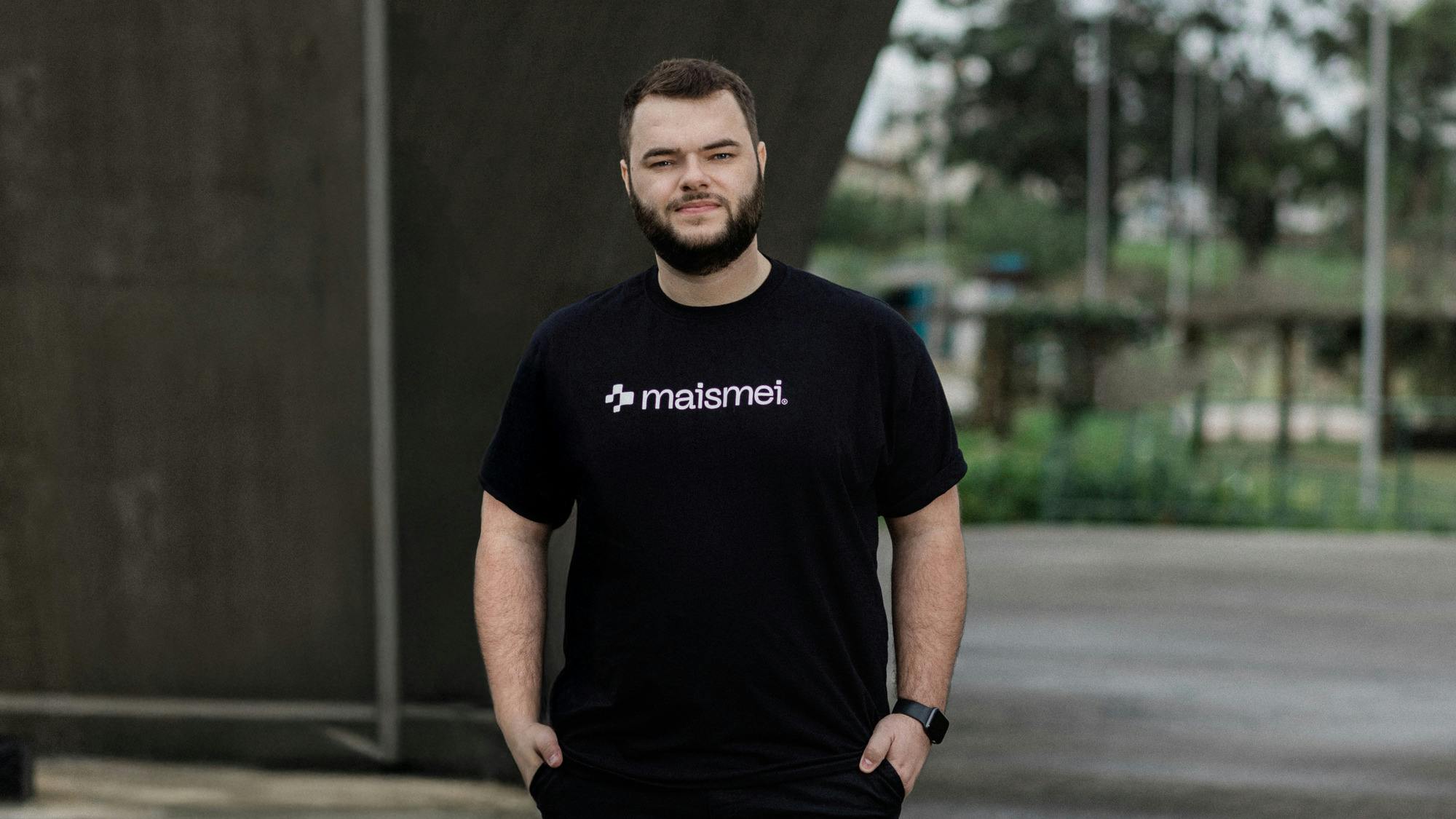
By the time Visma entered the conversation, MaisMei was already a substantial Brazilian success story. Founded six years ago by Mateus Vicente, a friend and his brother, the company had grown from a part-time technical project into a platform serving around four million clients, with roughly 25% market share.
MaisMei serves entrepreneurs in Brazil, a crowded market where trust can be as important as product functionality. For Vicente, that context shaped the decision to sell. The right buyer had to recognise the value of the product, the team and the customer trust the company had built.
From the first conversations, Visma gave Vicente confidence that MaisMei could join a larger group without losing the people, product focus and local knowledge behind its growth.
Built for entrepreneurs
Vicente is a front-end developer by background and wrote the first lines of code himself. In the beginning, he was still working another job, which meant MaisMei was built at night, with limited time and little money.
His motivation was practical and personal. After years of building products for other entrepreneurs, Vicente wanted to create something of his own. “I had built companies for other entrepreneurs,” he recalls. “I wanted to create something for myself.”
The company made money in its first year, but its more important decision came soon afterwards. The founders had to choose whether to keep the business small and profitable, or reinvest and build something larger.
They chose to reinvest and sharpened its focus on helping entrepreneurs.
“We chose to put the money back into the company, investing in the brand, the product and a clearer proposition for entrepreneurs.” Vicente says.
Growth with technical discipline
MaisMei’s first major milestone was reaching one million clients. For Vicente, that number showed the product had moved beyond early traction and become a meaningful part of the market.
Today, MaisMei serves around four million clients. Vicente attributes that growth to two strengths: good people and technical preparation.
“We have good professionals here,” he says. “They are very good at this work.”
As a technical founder, Vicente has stayed especially close to product and development. He believes that closeness helped the company improve quickly while preparing for scale.
“We prepared everything to scale,” he explains.
Choosing Visma
MaisMei had received approaches before. Some came when the company was only two years old and already growing quickly as a bootstrapped business. Later, the founders explored the market to understand their options, but the proposals did not feel right.
When discussions restarted last year, several offers were on the table. Visma stood out because its approach respected what MaisMei had already built.
What stood out to Vicente was Visma’s commitment to continuity. The company wanted MaisMei’s builders to remain part of its future, preserving the team and the way the business worked. “The people in the company are very important to us,” he says.
That mattered because MaisMei’s growth was closely tied to its team, product logic and understanding of Brazilian entrepreneurs. Visma gave Vicente confidence that the company could join a larger group without losing its identity.
The onboarding test
The first months after an acquisition often reveal whether the promise made during negotiations was real. For Vicente, MaisMei’s onboarding into Visma has confirmed the decision.
The work has been demanding. MaisMei has had to keep growing locally while adapting to new systems, governance and reporting requirements. Security has been one of the clearest areas of impact, helping the company identify gaps and understand where stronger systems and people were needed.
Financial reporting has also required adjustment. MaisMei operates in Portuguese and in the Brazilian market, but now reports within a wider international structure involving different currencies and regional teams.
Vicente does not describe the process as easy. He describes it as useful. It has forced the company to check its numbers carefully, improve routines and build stronger foundations.
What has stood out is the way Visma has handled the transition.
“We don’t have pressure here,” he says. “I have pressure on myself to do this.”
When Vicente needed more time to prepare a report, the response was simple: send it when it is ready. For a founder entering a larger international group, that kind of patience leaves a strong impression.
Trust, inside and outside the company
Visma’s impact is also visible in the market. Vicente describes Brazil as a space with many companies offering similar services and some operators damaging customer confidence. In that environment, credibility matters commercially.
“Our brand is very strong here,” Vicente says. “If we join the Visma group, we are more trustable.”
The acquisition has also changed how candidates see MaisMei. Soon after joining Visma, the company opened 10 roles and received strong interest. It was no longer seen only as a start-up, but as part of a global group with greater stability and reach.
Even so, the wider Visma network has quickly become one of the clearest benefits. Vicente points to support from other entrepreneurs, board members and peers who understand what it means to keep growing a local business while joining a larger group.
For MaisMei, Visma’s first impression has lasted because it has been backed by action: respect for the team, patience during onboarding, practical support and a clear interest in preserving what made the company successful.
When asked about the most difficult part of the transition, Vicente laughed before answering. “For me, the hardest part is the language,” he says. “I know MaisMei, our customers and the Brazilian market deeply. The challenge now is explaining that story in English.”

About the episode
Voice of Visma
Welcome to the Voice of Visma podcast, where we sit down with the business builders, entrepreneurs, and innovators across Visma, sharing their perspectives on how they scale companies, reshape industries, and create real customer value across markets.

Diana Kigyossy

Benedikte Lyngbø

Holli Hatherly

Berit Braut

Mandy Burger

Victoria Bondarchuk

Jet Bouwman

Brian Ye

Lilja Helgadottir

Carina Ramsøy

Kejsi Gjordeni

Martin Olstad

Claus Dahl

Vlad Boldura

Kaja Falck-Ytter

Linn Kjærland

Ida Nicoline Glosimot

Stina Wahlsten

Pieter Bijl

Emily Northway

Rie Jørgensen

Henriette Veiby

Magnus August Lien

Philip Scarampi

Ari-Pekka Salovaara

Helle Hobbelhagen

Alexander Lystad

Ida Strande Markman

Amanda Lundius Mörck

Isabel Arkvik

Gina Ross Eriksen (former employee)

Juliette Prado (former employee)

Anne-Grethe Thomle Karlsen (former employee)
Related content